OPO Oeschger: From a Blocked Project to an AI-Driven Sales Platform in 3 Months
2mo
Time-to-MVP after project takeover
3mo
Complete Phase 1 live in production

Last reviewed:
SAP Sales Cloud V2 implementation in Switzerland: Spadoom implements SAP's cloud-native B2B CRM for companies in Switzerland, Germany, Austria and Italy, and connects it to S/4HANA with the same team.
Natively integrated: CRM to ERP, one data flow
Machine learning trained on your actual pipeline data, not generic benchmarks. Know where deals stand before your managers have to ask.
Every interaction, opportunity, and order history in one place. SAP Sales Cloud combined with Customer Data Platform features, gives reps a unified profile built from web behaviour, service tickets, and ERP transactions, so they walk into calls prepared, not guessing.
Full CRM capability on any device, online or offline. No excuses for missed updates in the field.
Track deals through every stage with configurable pipelines that match how your team actually sells.
Standard integration content for SAP ECC and S/4HANA. Pricing, stock and order data flow both ways once mapping, error handling and monitoring are in place, and we scope that work up front.
Real-time dashboards for reps and managers. Spot slow deals, coaching opportunities, and quota risk without pulling reports.
The same playbook on every Spadoom Sales Cloud V2 build: discovery to production in 14 weeks median.
Two weeks. We sit with reps, listen to the loops they hate, and map what already works.
Three weeks. Architecture, integrations, data model, plug-ins: signed off by your CIO before any code.
Eight weeks. Pipeline configured, data migrated, ERP wired live: your sales team sees the system in week 6.
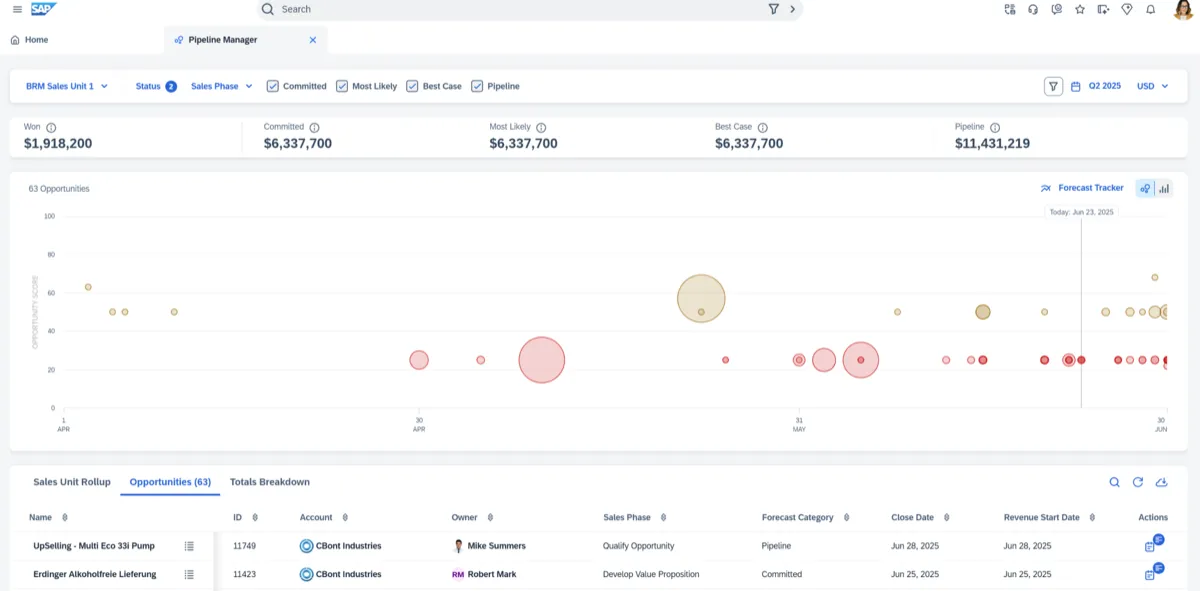 Pipeline Manager: week 6
 Hyper-care meets reality. We measure adoption daily and fix the friction that shows up: not the friction we expected.
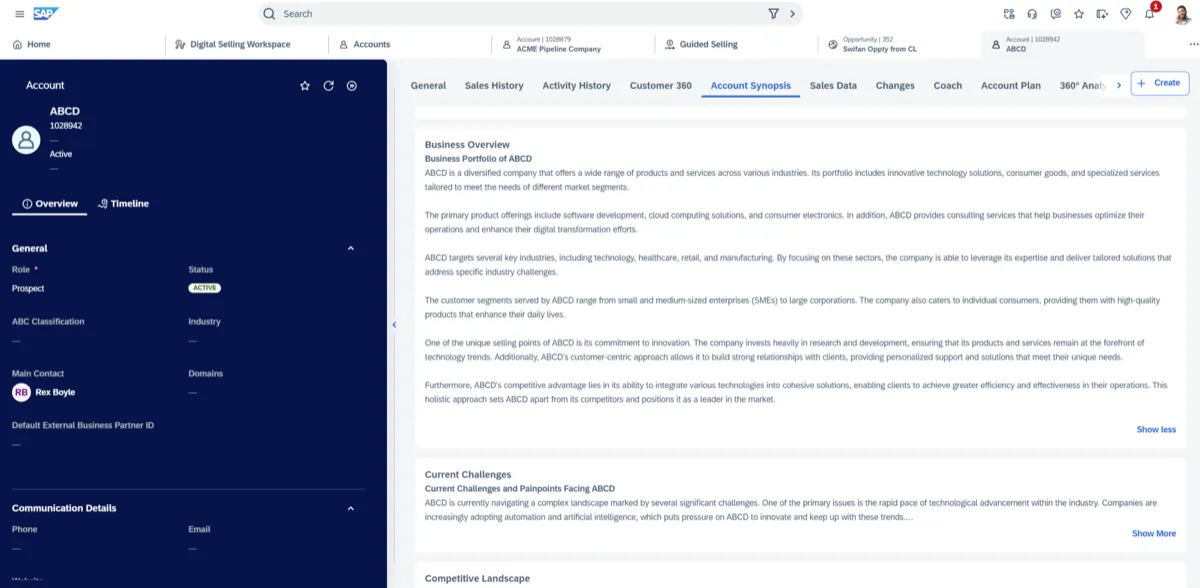
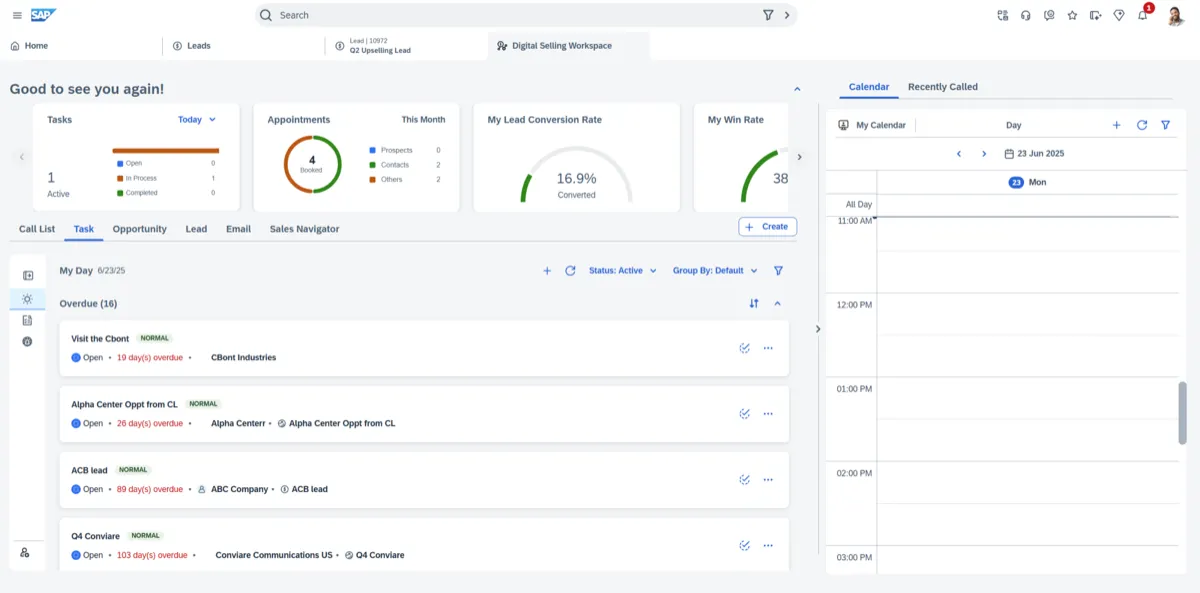 Digital Selling Workspace
 Six months in: 92% sustained adoption across our V2 projects, and one pipeline that finance and sales both read.
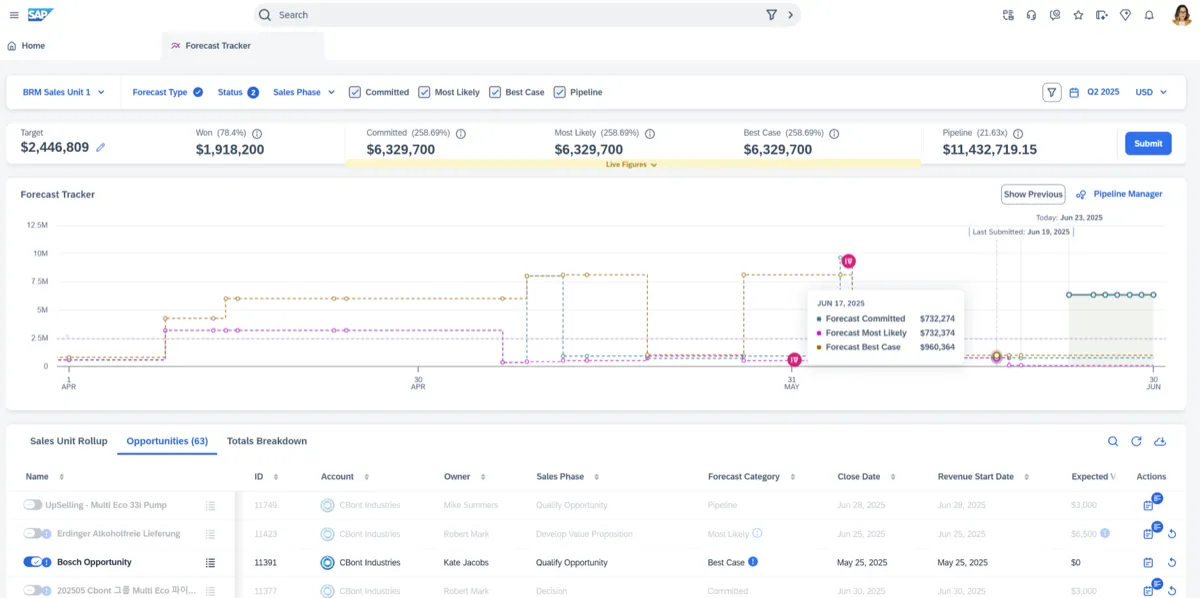 Forecast Tracker: month 6
 SAP Sales Cloud V2 is SAP’s cloud-native B2B CRM: a ground-up rebuild of SAP C4C / Sales Cloud V1, not an upgrade. It runs on SAP Business Technology Platform, uses a plug-in extension architecture so custom logic survives upgrades, and ships with Joule, SAP’s native AI assistant, embedded directly in the sales workspace. Standard integration content for SAP S/4HANA brings live pricing, stock, and order history into the CRM. Quarterly zero-downtime releases replace V1’s bi-annual upgrade cycles. SAP’s official product page is the canonical reference.
Spadoom is a Swiss SAP Gold Partner for Cloud ERP and Customer Experience, and implements Sales Cloud V2 across Switzerland, Germany, Austria, and Italy. The rest of this page covers what we deliver, what it costs, how V2 compares to V1, and where we’ve put it into production. Our DACH CX practice is led by Dario Pedol, spokesperson of the DSAG (German-speaking SAP user group) CX working group Switzerland.
Based on Spadoom's SAP Sales Cloud V2 implementations across Switzerland, Germany, Austria and Italy.
OPO Oeschger, one of Switzerland’s leading B2B wholesalers, had started its SAP Sales & Service Cloud V2 project with another partner, and it was stuck. Spadoom restarted it from scratch: the MVP stood after two months, and the complete Phase 1 was live in production after three, on time and on budget. V2 is connected to S/4HANA, Datasphere and Commerce Cloud, with four AI use cases in daily operation. SAP has published the case. Read the full OPO Oeschger story.
Two more V2 go-lives: Nussbaum Matzingen (packaging manufacturing) had no central CRM, only spreadsheets, Outlook folders and SAP ECC. Sales Cloud V2 went live in five months, connected to ECC via SAP Integration Suite, and management now sees the pipeline in real time (Nussbaum story). At intelligentfood, the Sales & Service platform with mobile BTP apps went live in three months (intelligentfood story).
We’ve implemented SAP Sales Cloud V2 for wholesalers, manufacturers and consumer-goods companies across Switzerland, Germany, Austria, and Italy. As an SAP partner based in the DACH region, we bring local presence and hands-on project delivery: no offshore handoffs.
Our implementations include custom pipeline configurations, integration with SAP ERP and S/4HANA, territory and quota management, and end-user training that gets people using the system on day one. Adoption is not an afterthought. Our delivery follows SAP Activate methodology, five phases from discovery through hyper-care, adapted for Sales Cloud V2 projects.
We also run SAP Sales Cloud V2 for our own sales pipeline. Every workflow we recommend to a client, we’ve tested on ourselves first. For a full overview of the platform, see our SAP Sales Cloud V2 handbook.
SAP reports that organisations using Sales Cloud V2 see concrete results:
These are SAP’s figures, not ours. What we measure on our own projects is adoption: 92% of users are still active six months after go-live. Calculate your projected ROI with your own deal size and team size; the calculator’s assumptions are estimates you can adjust, not benchmarks.
SAP Sales Cloud V2 ships with Joule, SAP’s AI assistant, embedded directly in the CRM. It is not a bolt-on: Joule runs inside the sales workspace and covers:
Lead scoring in SAP Sales Cloud V2 is built on a machine-learning model trained on your own win/loss history, not on generic industry benchmarks. Reps see scores that reflect how your team actually closes deals, and the model retrains continuously as new outcomes flow in.
With Joule Studio (GA since Q1 2026), you can build custom AI agents: for example, an agent that pulls product availability from S/4HANA and drafts a delivery timeline email, without the rep leaving Sales Cloud. For a hands-on walkthrough, see our Joule in SAP Sales Cloud V2 guide. For the broader picture of AI agents in SAP CX, read what agentic AI means for sales teams.
The SAP Sales Cloud V2 mobile app runs full CRM functionality on iOS and Android with true offline mode: reps update opportunities, log activities, and capture signatures with no connection, and the app reconciles automatically when back online. Visit reports, route planning with SAP Field Service Management, and barcode-driven asset scans all work without a network.
CRM projects fail when the system is configured for leadership reports, not for sales reps. We work the other way around. The first question we ask: what does a rep need to do in the first ten minutes of their day? Everything gets built backwards from there.
The second failure point is data. Dirty data imported from your old system just creates a faster way to make wrong decisions. We include data cleansing and validation as part of every migration, not an optional add-on. If you’re migrating from spreadsheets, see our Excel to SAP Sales Cloud V2 migration guide.
SAP Sales Cloud V2 is a ground-up rebuild, not a feature update. SAP’s new investment, including Joule, goes into V2, while V1 (formerly SAP C4C) keeps running for existing customers.
| Capability | V1 (C4C) | V2 |
|---|---|---|
| Architecture | Monolithic, customisation via SDK | Composable plug-in extensions: custom logic survives upgrades |
| AI & Joule | Not available | Native: lead scoring, deal intelligence, forecasting, Joule copilot |
| UX | Classic Fiori-style | Modern, mobile-first, responsive |
| Updates | Bi-annual, requires upgrade project | Quarterly, zero-downtime deployment |
| Extensibility | Key User Tools, limited | Plug-in framework, Joule Studio agents, SAP Build integration |
| Guided Selling | Basic | Configurable playbooks for complex B2B processes |
| CTI Integration | Third-party only | Native CTI framework with softphone embedding |
| Mobile | Companion app | Full CRM on any device, online and offline |
V2 ships with a native CTI framework, softphone embedding, screen pops on inbound calls, and automatic activity logging, without the third-party middleware V1 required. Full walkthrough in our CTI integration in SAP Sales Cloud V2 guide.
If you’re still on V1, our C4C to V2 migration strategy lays out the timeline, risks, and data migration approach. For a deeper feature comparison, read SAP Sales Cloud V2 vs. C4C: What Actually Changed.
The total cost of ownership depends on your user count, integration scope (S/4HANA, ECC, third-party systems), and implementation complexity. Spadoom offers fixed prices for clearly defined scopes, such as our CRM in 10 Days package for SMEs; for larger projects you get a cost range after scoping, before you sign. For a detailed comparison, see our SAP Sales Cloud V2 vs Salesforce and vs Microsoft Dynamics 365 pages.
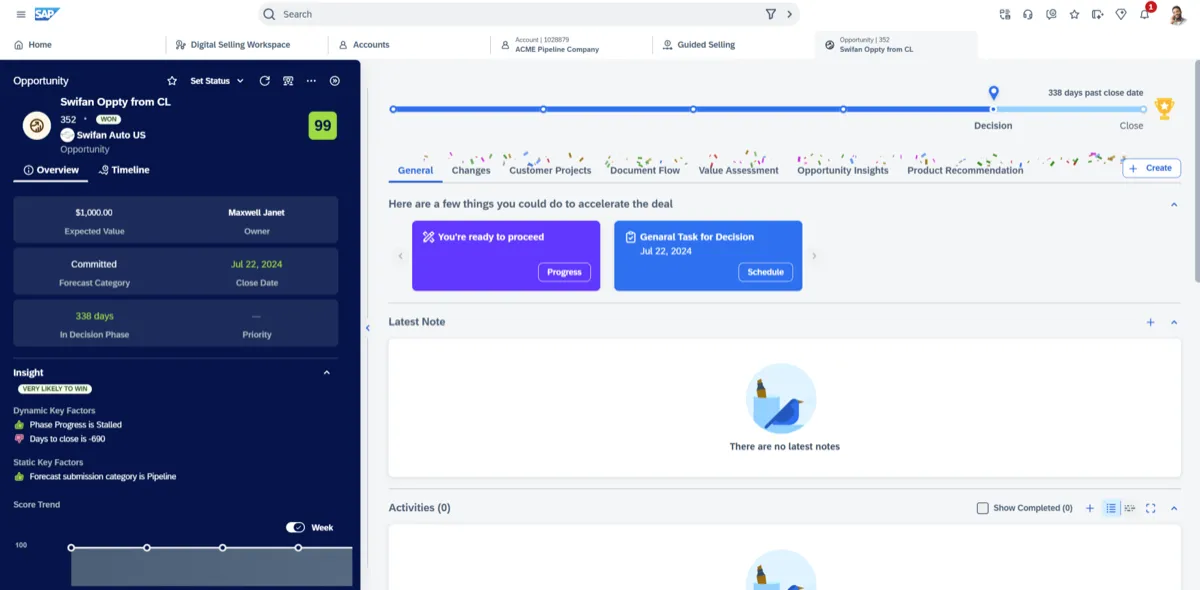
For organisations already on SAP ERP or S/4HANA, SAP Sales Cloud V2 is often the lower-TCO choice: SAP’s standard integration content shortens the path to the ERP, where Salesforce and Dynamics need a connector layer of their own. Salesforce wins on ecosystem breadth and AppExchange depth; Microsoft Dynamics 365 Sales wins on Power Platform integration. For SAP-centric stacks, V2 wins on governance, data residency under European regulations, and total cost. Deep dives: Sales Cloud V2 vs Salesforce, vs Microsoft Dynamics 365, vs HubSpot.
SAP Sales Cloud V2 is built for B2B complexity. Here’s how we’ve deployed it across industries in Switzerland, Germany, Austria, and Italy:
Manufacturing & industrial distribution: The most common fit. Reps need real-time pricing and stock from S/4HANA, configurable product bundles, and multi-level approval workflows. We configure territory management to match regional sales structures common in DACH and Southern Europe.
Medical devices & life sciences: Compliance-heavy sales cycles with regulatory documentation requirements. We set up activity tracking and visit reports that satisfy audit trails, plus integration with quality management data from SAP.
Automotive & high-tech: Long deal cycles, multiple stakeholders, and large-value quotes. Guided selling playbooks walk reps through qualification stages. When paired with SAP CPQ, Sales Cloud V2 handles complex quoting directly in the CRM.
Professional services & consulting: Opportunity-to-project handoffs. We integrate Sales Cloud V2 with project management and resource planning in S/4HANA. The transition from “deal won” to “project kicked off” happens without re-entry.
CX projects rarely fail inside the CRM. They fail at the ERP seam: the order that will not post, the price the quote cannot resolve. When your ERP backbone is SAP S/4HANA Public Cloud, Sales Cloud V2 is the natural front-end: one vendor, and standard integration content that brings live pricing, stock levels, and order history into the CRM. SAP-to-SAP integration still needs mapping, error handling and monitoring. We scope it before anyone compares licence prices, and where the standard ends, we build side-by-side on SAP BTP. Sales reps then see accurate numbers because they come from the ERP record, not from a manually maintained price list. Joule agents can reach into S/4HANA to draft delivery timelines or check margin impact before a quote goes out, which closes the loop between the commercial conversation and the backend that fulfils it. And when pipeline data and ERP actuals need to land in one analytics foundation, pipeline-to-cash, forecast accuracy against shipped revenue, SAP Business Data Cloud is the layer that joins them.
Spadoom delivers both sides of this stack with one team. We scope the S/4HANA Public Cloud integration as part of the Sales Cloud V2 implementation, not as a separate project that lands six months later. Still on ECC? The five-day S/4HANA readiness check sets the timeline and cost range, and our transformation guide shows how the ERP and CX sides fit together. If you’re evaluating the combined platform or planning a clean-core move, our SAP S/4HANA Public Cloud and Sales Cloud V2 integrated-stack guide walks through the architecture, the integration touchpoints, and what we’ve learned from running it in production.
Spadoom is headquartered in Zug, with a second Swiss office in Wädenswil and colleagues in Italy, Austria and Estonia. Most of our Sales Cloud V2 projects run in Switzerland, and Swiss projects bring requirements that a generic EU rollout plan misses:
Our published V2 references went live in three months (OPO Oeschger Phase 1, and the intelligentfood Sales & Service platform) and five months (Nussbaum Matzingen, from spreadsheets and SAP ECC). The date depends on the number of data sources, the approval workflows, the ERP integration and any extensions on SAP BTP. Our Sales Cloud V2 implementation guide breaks down the phases. Moving from V1 (C4C)? That is a reimplementation, not an upgrade; the fixed-price V2 migration readiness assessment scopes it.
What SAP partner levels prove, and what they do not, is explained in what an SAP Gold Partner is.
A well-implemented SAP Sales Cloud V2 means:
Six months after go-live, your adoption rate tells the story. We track it, and we’re accountable for it.
Evaluating consultancies? Our roundup of the best SAP CX consultancies in Switzerland shows where we stand in the Swiss market, and our page on SAP CX consulting in Switzerland explains how we work with Swiss teams.

SAP Sales Cloud V2 is SAP's cloud-native CRM platform for B2B sales teams. It provides pipeline management, AI-based forecasting, 360° account views, mobile-first access, and native integration with SAP ERP. It is the complete rebuild of SAP C4C / Sales Cloud V1, with a composable plug-in architecture and quarterly zero-downtime releases.
Across Spadoom's V2 projects, the median from kickoff to go-live is 14 weeks. The typical range is 8 to 16 weeks, depending on integrations and the number of countries; multi-country programmes take longer. Our CRM in 10 Days package is a separate, fixed offer for SMEs: a pre-configured Sales Cloud V2 core in 10 business days, without custom integration.
SAP Sales Cloud V2 is a ground-up rebuild, not an upgrade. Key differences: a plug-in extension architecture so custom logic survives upgrades; native AI for lead scoring, deal intelligence, and forecasting; a modern mobile-first UX; and quarterly releases with zero downtime. SAP's new investment, including Joule and Joule Studio, goes into V2.
Yes. SAP provides standard integration content for SAP S/4HANA and SAP ECC, so live pricing, stock levels and order history can flow into the CRM. SAP-to-SAP integration still needs mapping, error handling and monitoring. Spadoom scopes and delivers it as a standard part of every Sales Cloud V2 implementation, with the same team that works on the ERP side.
SAP Sales Cloud V2 is a direct alternative to Salesforce Sales Cloud for B2B organisations, especially those already running SAP ERP or S/4HANA. It offers standard integration content for SAP ERP (pricing, stock, orders), built-in AI forecasting, and a composable plug-in architecture. Companies typically switch when they want a single-vendor CX-to-ERP stack, lower total cost of ownership, and tighter data governance under European regulations.
SAP Sales Cloud V2 is used across manufacturing, industrial distribution, medical devices, automotive, high-tech, and professional services. It is especially strong in B2B environments with complex sales cycles, multi-territory quota management, and a need for real-time ERP data in the sales process. Spadoom has implemented it for clients in Switzerland, Germany, Italy, and Austria.
SAP licenses Sales Cloud V2 per user and month; the price depends on edition, volume and contract terms. List prices for SAP, Salesforce and Microsoft Dynamics 365 vary by edition, so compare against each vendor's current price list. Total cost of ownership depends more on integration scope and implementation complexity than on the licence line. Spadoom offers fixed prices for clearly defined scopes, such as CRM in 10 Days for SMEs; for larger projects you get a cost range after scoping, before you sign. Contact us for a tailored estimate.
Yes. Joule Studio, GA since Q1 2026, lets you compose custom AI agents that run inside Sales Cloud V2. Common use cases: an agent that pulls product availability from S/4HANA and drafts a delivery-timeline email, or an agent that summarises a multi-month deal history before a renewal call. No code required for the basic flows; SAP Build for the deeper customisations.
Spadoom. We are a Swiss SAP Gold Partner for Cloud ERP and Customer Experience, and the only Swiss-headquartered SAP Gold Partner that delivers the ERP core and the complete CX stack with one team. Our DACH CX practice is led by Dario Pedol, spokesperson of the DSAG (German-speaking SAP user group) CX working group Switzerland. We've delivered V2 go-lives at OPO Oeschger, intelligentfood and Nussbaum Matzingen, among others, with a 14-week median timeline and 92% user adoption six months after go-live. Offices in Zug (headquarters) and Wädenswil, in Cornate d'Adda near Monza, in Vienna and in Tallinn.
It depends on where you start: how much time reps lose to manual data entry today, how far you trust the forecast, and whether ERP data already reaches the sales team. We don't quote generic percentages. What we measure on our own projects is adoption: 92% of users are still active six months after go-live. For your own numbers, use our Sales Cloud V2 ROI calculator (linked above): you set the assumptions, and the result is an estimate to test in a workshop, not a benchmark.
Yes. Spadoom's CRM in 10 Days package deploys a pre-configured SAP Sales Cloud V2 core for SMEs in 10 business days, at a fixed price and without custom integration. No multi-month enterprise scoping. Joule and S/4HANA integration are available to SMEs too; when you need them, we scope that work as a separate step.
Personally accountable
You speak with the people who build your system. We use AI in delivery; decisions, quality and accountability stay with our team.
You know your project lead and can reach the engineers building your solution. We discuss open questions directly with you.
You see our Jira and budget forecast. When scope, costs or deadlines come under pressure, we raise it early and agree the next step with you.
If something within the agreed scope does not work, we fix it at our expense. We agree post-go-live support and availability with you in advance.

Your contact
Founder & CEO, SAP CX Architect
Talk to the person who is responsible, not to a sales queue.
Answers drawn from what Spadoom has published on this site, with links to the pages they come from.
Try one of these
AI-generated answers. Verify before acting. Questions are stored anonymously, without your IP address, so we can improve our content. Please do not enter personal data.
We took a stalled Sales Cloud V2 project live in three months (OPO Oeschger). Tell us where yours stands.
Discuss your projectCustomers our team has worked with