ANWR Group: High-Performance for Millions of Product SKUs
5M+
Product SKUs managed centrally
80%
Faster product data sync

Last reviewed:
B2B and B2C commerce built to handle real catalogue complexity. We launched it in 90 days for Franke and scaled it to millions of SKUs for industrial distributors. We know what it takes.
Natively integrated: CRM to ERP, one data flow
Headless Angular-based frontend decoupled from the commerce engine. Performance, flexibility, and full control over the customer experience.
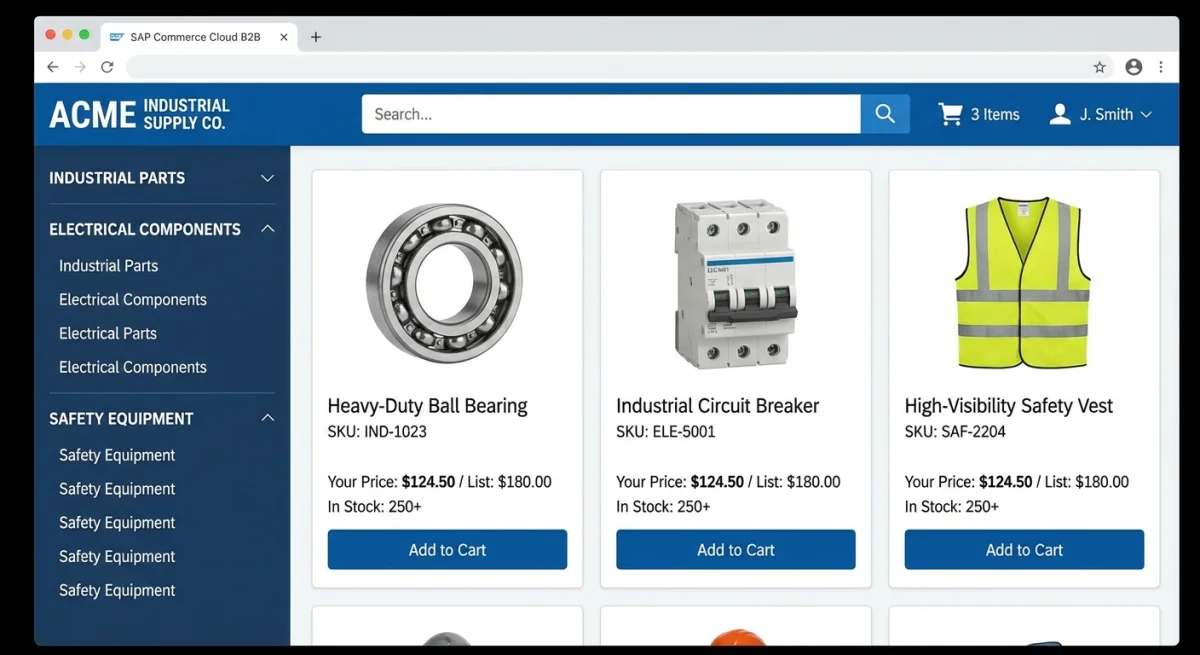
Account-based pricing, punch-out, order approval workflows, and reorder lists. Everything a B2B buyer expects.
Rich product catalogue with variants, bundles, and localisation. Works with millions of SKUs without performance compromises.
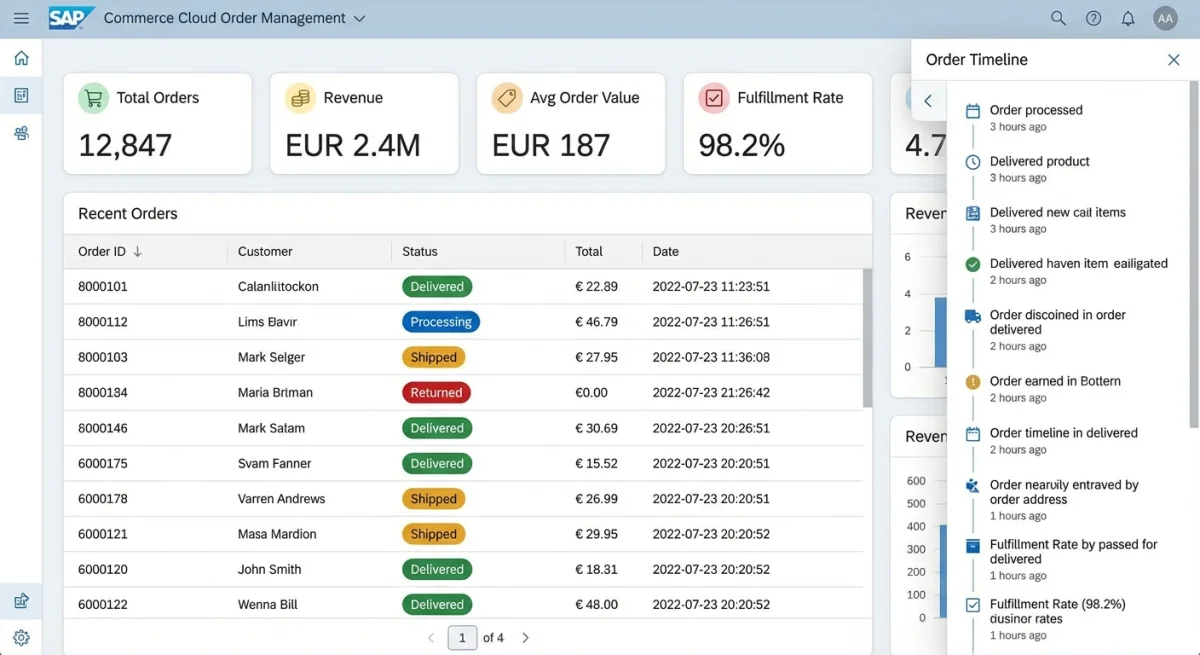
Multi-warehouse, multi-channel order orchestration. Returns, splits, and backorder handling out of the box.
Segment-based content and promotions. Serve different experiences to different customer groups without custom development.
Pricing, stock levels and order data from SAP ECC and S/4HANA through SAP's standard integration content. We scope mapping, error handling and monitoring up front.
SAP Commerce Cloud is SAP’s enterprise e-commerce platform for B2B and B2C selling, hosted as a managed cloud service on Microsoft Azure. Formerly known as SAP Hybris, it ships a product catalogue engine built for millions of SKUs, customer-specific pricing from SAP condition records, multi-warehouse order management, and standard integration content for SAP S/4HANA. Modern implementations use SAP Composable Storefront, an Angular-based headless PWA, formerly Spartacus, to decouple frontend and commerce engine. SAP’s official Commerce Cloud product page is the canonical reference. SAP has been named a Leader in the Gartner Magic Quadrant for Digital Commerce 11 years running (2014–2025).
Spadoom is a Swiss SAP Gold Partner for Cloud ERP and Customer Experience, and implements Commerce Cloud across Switzerland, Germany, Austria and Italy, with the ERP integration delivered by the same team. Our DACH CX practice is led by Dario Pedol, spokesperson of the DSAG (German-speaking SAP user group) CX working group Switzerland. The rest of this page covers which edition fits which buyer, what we deliver, how Cloud Edition compares to the new ERP Edition, what it costs, and where we have put it into production.
Franke 90-day go-live: SAP Quality Award winner, 2024. Gartner MQ Leader citation: SAP press, November 2025.
Our most-cited project. Franke had a stalled custom B2B e-commerce build. We replaced it with SAP Commerce Cloud in 90 days: composable storefront, B2B pricing, full SAP ERP integration. The result: an SAP Quality Award for implementation quality and a platform that now serves Franke’s global distribution network. Read the full Franke story for the timeline, migration approach, and lessons learned.
In 2026 SAP ships three commerce products under similar names. Buyers regularly ask us which one they actually need. The short answer:
| Edition | Best for | Architecture | Go-live | Where it lives |
|---|---|---|---|---|
| SAP Commerce Cloud (Cloud Edition) | Enterprise B2B and B2C with complex catalogues (≥100k SKUs), multi-country, deep ERP integration | Standalone commerce engine, composable storefront, OCC REST APIs | Set after discovery (Franke: 90 days) | SAP-managed cloud on Azure |
| SAP Commerce Cloud, ERP Edition | SMEs and mid-market on S/4HANA Public Cloud who need B2B commerce without a separate platform | B2B storefront built into S/4HANA Public Cloud, master data via SAP Business Data Cloud, Joule included | SAP targets 90 days | Inside S/4HANA Public Cloud |
| SAP Commerce (on-premise / Hybris) | Existing customers on the legacy platform | Self-hosted, monolithic | n/a (in end-of-mainstream-maintenance transition) | Customer data centre |
Cloud Edition is the right answer for most enterprise scenarios, and the focus of this page. It is what we built for Franke and what we migrate hybris customers onto.
ERP Edition is the credible new SAP answer for the mid-market on S/4HANA Public Cloud, unveiled at SAP Sapphire Orlando in May 2026. Spadoom is one of the first pilot partners delivering it. See our ERP Edition deep dive and the Cloud Edition vs Shopify Plus and ERP Edition vs Shopify Plus comparisons.
On-premise hybris is in transition. If you are still on it, our Hybris end-of-life migration checklist and 90-day migration playbook lay out the path off it.
At SAP Sapphire Orlando in May 2026, SAP unveiled the SAP Commerce Cloud, ERP Edition: a lightweight B2B commerce variant built into S/4HANA Public Cloud, with master data flowing through SAP Business Data Cloud and Customer Data Cloud, Joule included, and a 90-day implementation target. It is the first credible SAP commerce answer for the mid-market on cloud ERP, and Spadoom is one of the first pilot partners delivering it. For the full architectural and strategic breakdown, see our DSAG-CX-spokesperson take on the ERP Edition.
Our track record in SAP Commerce Cloud is long and specific. We built Franke’s award-winning B2B platform in 90 days: a project that replaced a stalled custom build and won an SAP Quality Award. We’ve migrated distributors off legacy hybris accelerators to SAP Commerce Cloud Composable Storefront. We’ve scaled catalogue management for companies with 3+ million SKUs across multiple countries and languages.
As an SAP Gold Partner with offices in Switzerland, Italy, Austria, and Estonia, we bring local presence across the DACH region and Southern Europe. No offshore handoffs. The architects who scope your project are the same people who configure your storefront and train your team. When something breaks at 8 AM on a Monday, you call someone in your time zone.
What we handle end to end:
Our delivery follows SAP Activate methodology, five phases from discovery through hyper-care, adapted for SAP Commerce Cloud projects. Discovery takes two weeks. We map your catalogue structure, pricing rules, order workflows, and integration points before a single line of code is written.
For a full technical overview of the platform, from product content management to order orchestration, see our SAP Commerce Cloud A-Z Handbook.
E-commerce projects live or die on numbers, so we are careful about which ones we quote. What our own projects show: Franke cut manual orders by 75% after moving to SAP Commerce Cloud, and Distrelec’s headless re-architecture shortened time-to-market by 70% and lifted conversion by 15%. Both are documented in the case studies linked on this page.
Where the gains come from is no secret. B2B buyers who can check stock, see their contract prices and reorder online stop calling or emailing inside sales for routine orders, and the errors of phone and fax entry disappear. What that is worth depends on your order volume, your channel mix and how much of today’s ordering is manual.
We build the business case with your own order data during discovery, not from generic benchmarks.
The analyst community has consistently recognised SAP Commerce Cloud. In the 2025 Gartner Magic Quadrant for Digital Commerce, SAP was named a Leader for the 11th consecutive year. That reflects continued investment in composable architecture, B2B capabilities, and AI-driven personalisation.
SAP Commerce Cloud is also a Leader in both the IDC MarketScape for Enterprise B2B Digital Commerce (2023–2024) and the IDC MarketScape for Enterprise B2C Digital Commerce (2024).
On G2 (based on verified user reviews, 2025):
| Category | SAP Commerce Cloud | Shopify Plus | Adobe Commerce |
|---|---|---|---|
| Overall Rating | 4.0 | 4.4 | 4.0 |
| Ease of Use | 8.4 | 8.9 | n/a |
| Quality of Support | 8.6 | 8.4 | n/a |
Shopify Plus leads on ease of use: expected for a platform designed for rapid setup and smaller catalogues. SAP Commerce Cloud scores higher on quality of support and matches Adobe Commerce overall despite serving a more complex B2B market. For organisations already running SAP ERP, the integration advantage compounds the platform advantage. For head-to-head comparisons, see our SAP Commerce Cloud vs Shopify Plus and vs Adobe Commerce analysis pages.
Platform reliability at scale: During Cyber Week 2025, SAP Commerce Cloud processed $17.8 billion in gross merchandise value (up 40% year-over-year) with 100% platform uptime. The previous year saw 18.2 million orders during the same peak period, again, zero downtime (source: SAP Commerce Cloud Year in Review, 2025).
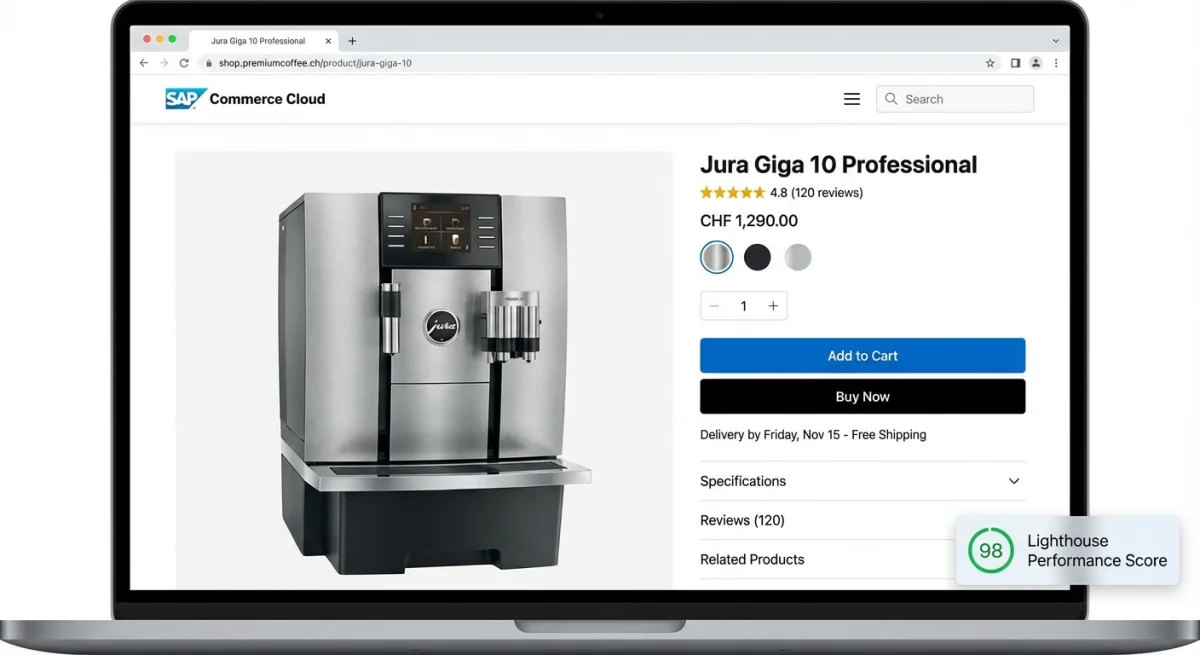
If you’re starting fresh or replacing an older hybris accelerator, composable storefront is the right direction. SAP Commerce Cloud Composable Storefront (formerly Spartacus) decouples the frontend from the commerce engine entirely, see the official SAP Composable Storefront documentation for the full architecture reference. The storefront is an Angular-based progressive web app (PWA) that talks to the commerce backend via OCC REST APIs.
What that means in practice:
When to use the accelerator instead: If you need an internal B2B portal where function matters more than UX, the accelerator approach still works. It is faster to configure, needs less frontend skill and covers much of standard B2B self-service out of the box. We’ll tell you which fits your situation, not the one that maximises project scope.
For a deeper dive on composable architecture, OCC APIs, and implementation patterns, see our SAP Commerce Cloud A-Z Handbook.
This is a question we get every week. SAP directs new feature development to SAP Commerce Cloud; the on-premise version still receives maintenance and security patches, but no new capabilities. If you’re running SAP Hybris on-premise, it pays to plan the move before a deadline plans it for you.
Our migration methodology:
We don’t rip and replace. We’ve developed a phased approach based on what we learned migrating Franke, which won an SAP Quality Award:
The new storefront goes live before the backend migration is finished, so customers get the better experience early while the backend moves behind the scenes. Your actual timeline comes out of the assessment.
What trips people up: Data migration is not a copy-paste job. Product classifications, price lists with thousands of condition records, and customer-specific catalogue views all need validation. We build automated migration scripts with data quality checks at every stage. If your legacy system has 50,000 products with incomplete attributes, we catch that in week one, not in week twelve.
The other common mistake is trying to replicate every customisation from the old system. In most migrations, a good share of the legacy extensions turns out to be unnecessary. We help you separate what matters from what was built to work around old platform limitations.
We documented the full playbook, timelines, risk mitigation, and data migration patterns, in our 90-day migration playbook. It’s based on real projects, not theory.
SAP Commerce Cloud licensing is based on gross merchandise volume (GMV) and traffic tiers, not a simple per-user price. That makes direct comparison tricky, but here’s a realistic picture:
| SAP Commerce Cloud | Shopify Plus | Adobe Commerce (Magento) | |
|---|---|---|---|
| Pricing model | GMV + traffic tiers | Revenue-based | Licence + GMV tiers |
| Annual licence (mid-market) | Depends on GMV, traffic and modules | See current vendor price list | See current vendor price list |
| B2B features | Native: punch-out, account pricing, approval workflows | Limited, requires apps | Available with B2B module |
| SAP ERP integration | Standard integration content (mapping and monitoring still needed) | Third-party middleware | Third-party middleware |
| Multi-country / multi-brand | Built-in with shared catalogue | Separate stores (Plus only) | Multi-store with shared backend |
| Composable / headless | Yes (Composable Storefront) | Hydrogen (newer) | PWA Studio / Hyva |
| Hosting | SAP-managed cloud (Azure) | Shopify-managed | Self-hosted or Adobe-managed |
The real cost question is total cost of ownership. If you already run SAP ERP, SAP’s standard integration content gives Commerce Cloud a shorter path to pricing, stock and orders than a third-party connector layer. It does not make integration free: mapping, error handling and monitoring still have to be built and run. Whether the higher licence pays off depends on your order volume, your B2B complexity and how much of the ERP process the shop has to reach. We work that out with you before you sign.
Spadoom gives you a fixed price for clearly defined scopes and, for larger programmes, a cost range after discovery, covering implementation, training and hyper-care. Change requests are agreed before work starts, not discovered at month four.
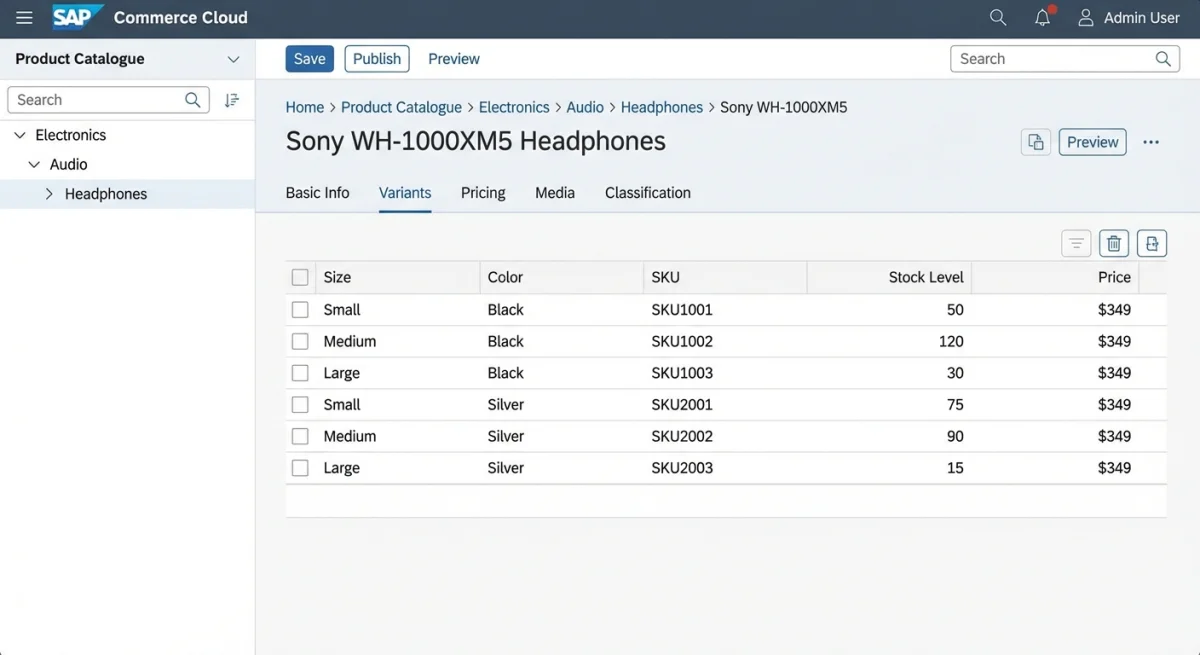
SAP Commerce Cloud is built for catalogue complexity and process depth. Here’s where we’ve deployed it:
Manufacturing and industrial distribution: The core use case. Distributors with 500,000+ SKUs need customer-specific pricing, multi-warehouse stock visibility, and order approval workflows. We configure punch-out catalogues for procurement system integration (SAP Ariba, Coupa) and set up reorder lists that let buyers repeat last month’s order in two clicks. Real-time stock and pricing from S/4HANA means no more “sorry, that price changed” emails after order submission. For companies with field sales teams, the same platform serves both the self-service portal and the sales rep’s order entry: same prices, same stock, one system.
Consumer goods and retail: B2C brands with high SKU counts, seasonal catalogues, and multi-country storefronts. SAP Commerce Cloud handles localised content, currency, tax rules, and shipping per market, all from a single catalogue. The personalisation engine serves different promotions to different customer segments without custom code. One catalogue, one order management system, one integration layer, but each country gets its own storefront, pricing, and fulfilment logic.
Automotive aftermarket: Parts catalogues are a special kind of complex. Vehicle fitment data, supersession chains, and cross-reference lookups on top of standard e-commerce. We’ve built SAP Commerce Cloud storefronts that integrate with TecDoc and ETKA catalogues, serving the right parts for the right vehicle without forcing buyers to know part numbers.
Food and beverage: B2B ordering with minimum order quantities, case-pack logic, delivery window scheduling, and temperature-controlled logistics integration. SAP Commerce Cloud’s order management handles split shipments across multiple warehouses and delivery routes. Route accounting integration with SAP ERP closes the loop from order to delivery to invoice. We’ve configured recurring order schedules that let restaurant and hospitality buyers set up weekly standing orders, so buyers no longer re-enter their regular products by hand.
SAP Commerce Cloud’s strongest differentiator is how it connects to the rest of your SAP landscape. This is not an abstract benefit: it directly affects your order accuracy, pricing consistency, and operational efficiency.
S/4HANA and ECC integration: Bidirectional, through SAP’s standard integration content. Stock on the storefront comes from S/4HANA, orders land in SAP as sales orders, and prices come from SAP’s condition records, so the price online matches the price in the ERP. That still takes mapping, error handling and monitoring, and we scope it up front. For Meier Tobler we built exactly this backbone on SAP Integration Suite.
SAP CPQ: For complex B2B quoting (configurable products, tiered pricing, multi-step approvals), CPQ plugs directly into Commerce Cloud so buyers configure and price products inside the same storefront session. Essential for manufacturers selling configurable industrial equipment, automotive aftermarket bundles, or any catalogue where price depends on configuration.
SAP Engagement Cloud (formerly Emarsys) (marketing automation): Connect your commerce data to SAP Engagement Cloud for abandoned cart recovery, post-purchase campaigns, and personalised product recommendations based on browsing and purchase behaviour. SAP provides standard integration content. Campaign performance data flows back into commerce analytics.
SAP Customer Data Platform: Unify customer profiles across your storefront, service desk, and marketing channels. CDP collects behavioural data from Commerce Cloud (product views, searches, purchases) and combines it with CRM and service interactions. The result: a single customer view that powers personalisation across every touchpoint.
SAP Customer Identity (CIAM): Enterprise-grade authentication and consent management for your storefront. Single sign-on across multiple brand sites, progressive profiling, and GDPR-compliant consent tracking. Essential for multi-brand or multi-country deployments where customers expect one login across all your properties.
When these systems work together, the storefront knows your customer across sales, service, marketing and ERP. A B2B buyer who called your service desk yesterday can see a follow-up when they log in today, and a campaign for high-value customers uses actual purchase data, not guesses.
Commerce projects rarely fail in the storefront. They fail at the ERP seam: the order that will not post, the price the shop cannot resolve, the stock figure nobody trusts. Spadoom delivers the ERP side with the same team, from SAP S/4HANA Public Cloud to side-by-side extensions on SAP BTP. Still on ECC? The five-day S/4HANA readiness check sets the timeline and cost range, and our transformation guide shows how commerce, CRM and ERP fit together. SAP documents the supported integration capabilities of SAP Integration Suite.
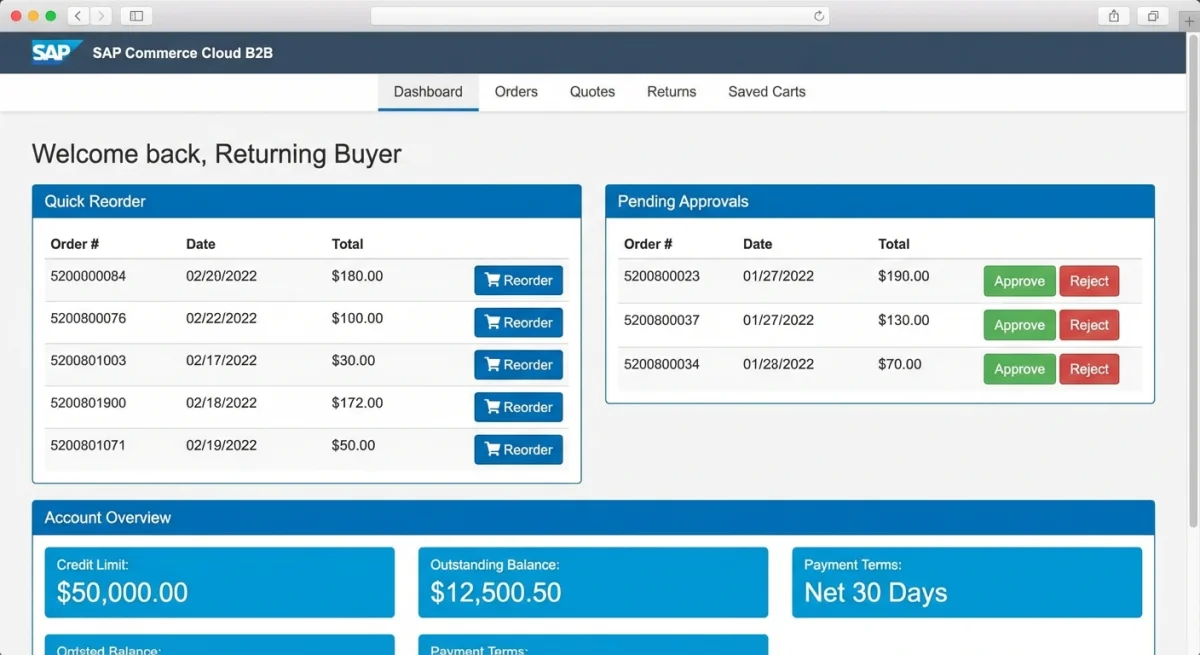
Spadoom is headquartered in Zug, and Switzerland is our home market, not a flag on a coverage map. Our two most-cited Commerce Cloud references are Swiss companies. Franke, the Swiss kitchen and home solutions group, is the 90-day rebuild that won an SAP Quality Award and cut manual orders by 75% across 10+ global channels. Distrelec, the B2B electronics distributor with Switzerland as its home market, is where our headless re-architecture reduced time-to-market by 70% and lifted conversion by 15%. And for Meier Tobler, the Swiss building-technology supplier, we built the SAP Integration Suite backbone that keeps their online shop and S/4HANA in real-time sync: over 1 million messages a month.
Implementing commerce for the Swiss market comes with requirements that standard EU playbooks miss, and we build them in from day one:
We documented the full Swiss and DACH delivery approach, payments, VAT corridors, nDSG vs GDPR, logistics, in our Commerce Cloud in Switzerland and DACH implementation guide. How we work with Swiss teams across ERP and CX is summarised on our page on SAP CX consulting in Switzerland.
A well-implemented SAP Commerce Cloud means:
Six months after go-live, we measure these points with you against the baseline from discovery. We stay accountable through hyper-care and beyond.
Ready to discuss your SAP Commerce Cloud project? Whether you’re building a new storefront, migrating from on-premise hybris, or replacing a platform that’s holding you back, we’ll give you an honest assessment. Start the conversation or explore our CRM in 10 Days package if you’re also looking at SAP Sales Cloud.
Evaluating providers? Our market roundup of the best SAP Commerce Cloud implementation partners in Switzerland shows how we compare, and who else deserves a look.

SAP Commerce Cloud (formerly SAP Hybris) is SAP's enterprise e-commerce platform for B2B and B2C online selling. It provides a product catalogue engine, customer-specific pricing, order management, personalisation, and real-time integration with SAP ERP for inventory and pricing data. It supports both traditional accelerator and modern composable storefront (headless) architectures.
SAP Commerce Cloud Composable Storefront (formerly Spartacus) is a JavaScript-based, headless frontend for SAP Commerce Cloud. It decouples the presentation layer from the commerce backend, enabling faster page loads, independent frontend deployments, and a modern Angular-based PWA experience. Composable Storefront is the recommended path for new implementations and accelerator migrations.
Yes. SAP Commerce Cloud has extensive B2B features including account-based pricing, punch-out catalogues, order approval workflows, customer-specific product visibility, reorder lists, and integration with SAP CPQ for guided selling. It is used by large B2B manufacturers and distributors managing complex catalogues of millions of SKUs.
SAP Hybris (on-premise SAP Commerce) has been transitioning customers to SAP Commerce Cloud (cloud-hosted). Customers still running on-premise should assess their migration path. Spadoom offers a structured migration programme covering platform assessment, composable storefront architecture, and phased go-live, so customers can launch on the cloud version before fully decommissioning on-premise.
SAP Commerce Cloud and Shopify serve different market segments. Shopify is a SaaS platform optimised for fast setup and smaller catalogues, while SAP Commerce Cloud is built for enterprise-grade complexity: multi-country rollouts, B2B account hierarchies, customer-specific pricing, punch-out integration, and real-time SAP ERP connectivity. Organisations that need deep back-office integration, complex product configuration, or multi-brand storefronts with shared catalogue infrastructure typically outgrow Shopify and require a platform like SAP Commerce Cloud. For a detailed feature-by-feature breakdown, see our SAP Commerce Cloud vs Shopify Plus comparison page.
SAP Commerce Cloud (Cloud Edition) licensing is based on gross merchandise volume (GMV) and traffic tiers; the amount depends on traffic, modules and number of storefronts, so ask for a current quote rather than trusting a range on a website. SAP Commerce Cloud, ERP Edition is tied to S/4HANA Public Cloud and follows a different commercial model. Implementation cost varies with catalogue size, integration complexity and number of storefronts. Spadoom gives you a fixed price for clearly defined scopes and, for larger projects, a cost range after discovery, before you sign. Contact us for an estimate based on your edition and business model.
SAP Commerce Cloud is used across manufacturing, industrial distribution, consumer goods, automotive and aftermarket, food and beverage, and high-tech. It is especially strong in B2B environments with complex product catalogues, customer-specific pricing, multi-country rollouts, and deep SAP ERP integration. B2C use cases include consumer brands with high SKU counts and omnichannel requirements. Spadoom has implemented it for clients across Switzerland, Germany, Austria, and Italy.
Two different products. SAP Commerce Cloud (Cloud Edition) is the standalone enterprise commerce platform, composable storefront, OCC APIs, real-time S/4HANA integration, built for large catalogues, multi-country rollouts, and complex B2B workflows. SAP Commerce Cloud, ERP Edition is a lightweight B2B storefront built directly into S/4HANA Public Cloud, with master data flowing through SAP Business Data Cloud and Joule included: designed for SMEs and mid-market on cloud ERP, with a 90-day go-live target. ERP Edition was unveiled at SAP Sapphire in May 2026. Spadoom is one of the first pilot partners and delivers both editions.
SAP Commerce Cloud is the cloud-hosted successor to SAP Hybris. SAP directs all new feature development, composable storefront, AI-driven personalisation, Joule capabilities, to the cloud version. On-premise Hybris is in transition through end-of-mainstream-maintenance; it still receives security patches but no new capabilities. Customers still running on-premise should plan their migration. Spadoom offers a structured, phased migration programme, documented in our 90-day Hybris-to-Commerce-Cloud playbook; your actual timeline comes out of the assessment.
Yes. SAP provides standard integration content between SAP Commerce Cloud and SAP S/4HANA or ECC for prices, stock, orders and customer master data. SAP-to-SAP integration still needs mapping, error handling and monitoring, and the available data and latency depend on editions and the configured scenario. We scope that work before anyone compares licence prices, and we deliver the ERP side with the same team.
Personally accountable
You speak with the people who build your system. We use AI in delivery; decisions, quality and accountability stay with our team.
You know your project lead and can reach the engineers building your solution. We discuss open questions directly with you.
You see our Jira and budget forecast. When scope, costs or deadlines come under pressure, we raise it early and agree the next step with you.
If something within the agreed scope does not work, we fix it at our expense. We agree post-go-live support and availability with you in advance.

Your contact
SAP Commerce Lead
Talk to the person who is responsible, not to a sales queue.
Answers drawn from what Spadoom has published on this site, with links to the pages they come from.
Try one of these
AI-generated answers. Verify before acting. Questions are stored anonymously, without your IP address, so we can improve our content. Please do not enter personal data.
We brought Franke’s SAP Commerce Cloud platform live in 90 days. Tell us what your shop has to do.
Discuss your projectCustomers our team has worked with