
What Are Agentic AI Systems and How Is SAP Using Them?

Dario Pedol
CEO & SAP CX Architect, Spadoom AG
Gartner says 40% of enterprise applications will have task-specific AI agents by end of 2026, up from less than 5% in 2025 (Gartner, 2025). Eight-fold increase in a single year. Not a gradual shift. SAP is one of the companies pushing it, with 14 new Joule Agents announced at SAP Connect 2025 and over 400 AI use cases embedded across its applications.
But what actually makes AI “agentic”? And is the technology ready for production, or are we still watching demos?
TL;DR: Agentic AI systems don’t wait for instructions. They observe, plan, and execute multi-step workflows autonomously. SAP has deployed 40+ Joule Agents across finance, HR, procurement, and CX. Gartner projects the agentic AI market will reach $450 billion by 2035 (Gartner, 2025). The tech is real, but governance and data readiness determine whether it works for you.
What Makes AI “Agentic”?
McKinsey’s November 2025 State of AI survey: 23% of organisations are already scaling agentic AI and another 39% are experimenting (McKinsey, 2025). Adoption is moving fast because the concept solves a real limitation of traditional AI.
Agentic AI refers to systems that operate with a clear goal in mind. Unlike tools that sit there waiting for someone to type a prompt, these systems observe, interpret, and take action on their own. The AI agent is software that works within digital environments to carry out tasks based on current conditions, not pre-written commands.
These agents follow logic designed around outcomes. They spot a stalled process, evaluate options, and take the next step without waiting for someone to tell them what to do. Whether they’re handling customer requests, processing vendor changes, or resolving internal tickets, the value is in their ability to follow through. That’s the difference between augmenting humans and de facto acting as a team member.
How Does Agentic AI Differ from Generative AI?
Generative AI produces content in response to a request. Writing a message, summarising a report.
Agentic AI takes that same information and acts on it. Completes the task and handles what comes next.
Simplest way I can put it: generative AI might draft an email. Agentic AI sends it, monitors the reply, and schedules a follow-up based on the outcome. One creates. The other acts.
What Are the Core Capabilities of Agentic AI Systems?
The agentic AI market is projected to grow from $7.55 billion in 2025 to $199 billion by 2034, a 43.84% CAGR (Precedence Research, 2025). That investment is flowing toward four capabilities that separate agentic systems from basic automation.
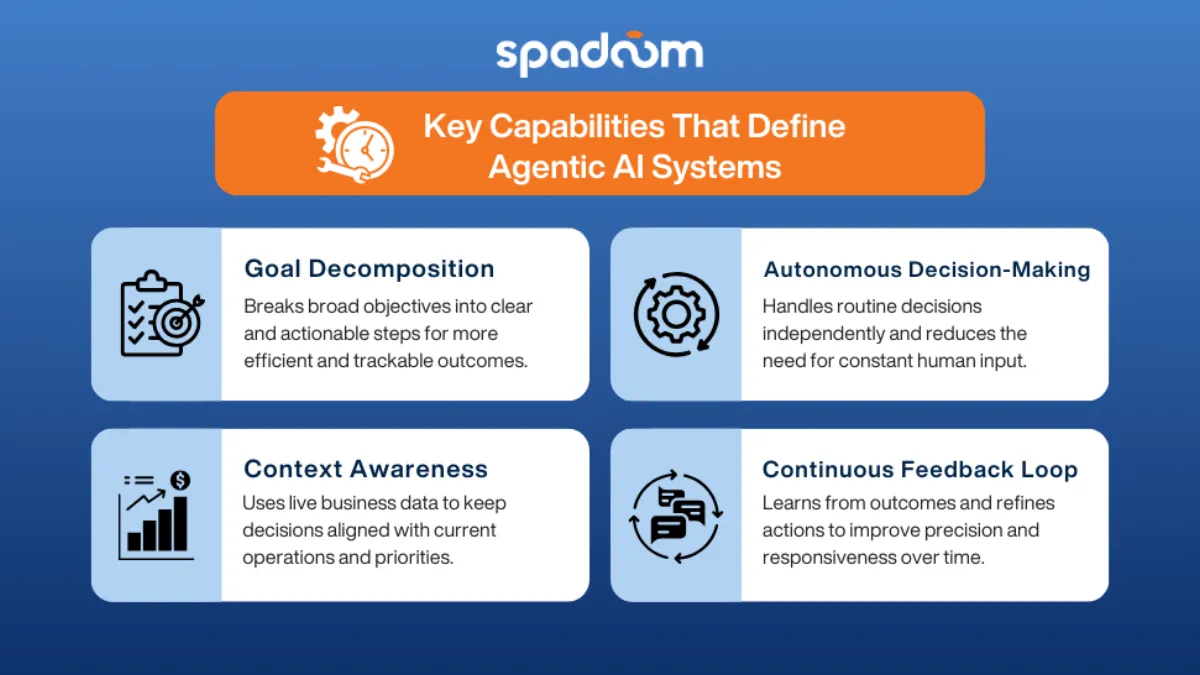
Goal Decomposition
Agentic AI handles complex objectives by breaking them into structured, trackable actions. In HR, for example, an agent can monitor recruitment progress, assess engagement levels, and interpret sentiment in candidate feedback. It helps teams focus on the right hires while keeping retention on the radar.
Autonomous Decision-Making
AI agents make operational decisions on their own, within predefined parameters. Approve recurring invoices. Sort service requests. Escalate issues based on urgency. No human input needed each time. This is where the real time savings come from.
Context Awareness
AI agents operate with full awareness of surrounding business conditions. They pull live signals from systems: inventory availability, customer priority levels, past interactions. Every decision reflects the current state.
An agent might prioritise a high-value customer’s request when stock is limited, or adjust a fulfilment timeline based on regional warehouse capacity. These decisions shift dynamically as new data arrives. That’s neat. And it’s something rule-based automation simply can’t do.
Continuous Feedback Loop
Agentic systems learn from the outcomes of each action. They evaluate results and adjust future behaviour, getting more precise over time. This is what separates them from rule-based automation: they get better. Continuously.
What Benefits Does Agentic AI Deliver in Enterprise Environments?
McKinsey research shows that AI-powered “next best experience” approaches improve customer satisfaction by 15-20%, increase revenue by 5-8%, and reduce cost to serve by 20-30% (McKinsey, 2025). Agentic AI amplifies these gains by removing the human bottleneck from routine decision chains.
Streamlined Operations
Here’s what I’ve seen in practice: agentic AI doesn’t just speed up individual tasks. It changes how responsibilities move between people, teams, and systems. In many companies, a single workflow passes through several hands before it’s done. AI agents cut through that by carrying out connected actions start to finish, eliminating delays caused by ownership gaps. That’s where the compounding effect kicks in.
Faster Turnaround
Agents respond instantly to system triggers. Tasks begin the moment new data shows up. This matters most in customer-facing scenarios where response time directly affects satisfaction and conversion. Minutes matter.
Scalable Personalisation
Agents adjust offers, support, or timing based on real-time behaviour. They help you personalise at speed without growing the team. McKinsey found that personalisation drives 5-15% revenue lift, and leading companies generate 40% more revenue from personalisation than average performers (McKinsey, 2025). That gap is worth paying attention to.
Better Use of Data
Agentic AI is especially effective where data labelling or review work eats up time. In trials across fintech and healthcare, agents reduced total annotation time by 52% by independently managing low-risk data and only flagging uncertain items for human review. The boring stuff, handled automatically.
Lower Operational Costs
AI reduces customer service costs by 25-30% on average, with cost per interaction dropping from $6-$8 (human) to $0.50-$0.70 (AI) (Master of Code, 2026). As more routine decisions get delegated to agents, the savings compound. And they compound fast.
Where Is SAP Deploying Agentic AI Today?
SAP’s systems already run agentic AI in day-to-day operations. With 400+ AI use cases across applications and Joule Studio reaching GA in Q1 2026 (AIMultiple, 2026), these agents span finance, procurement, service, HR, and CX.
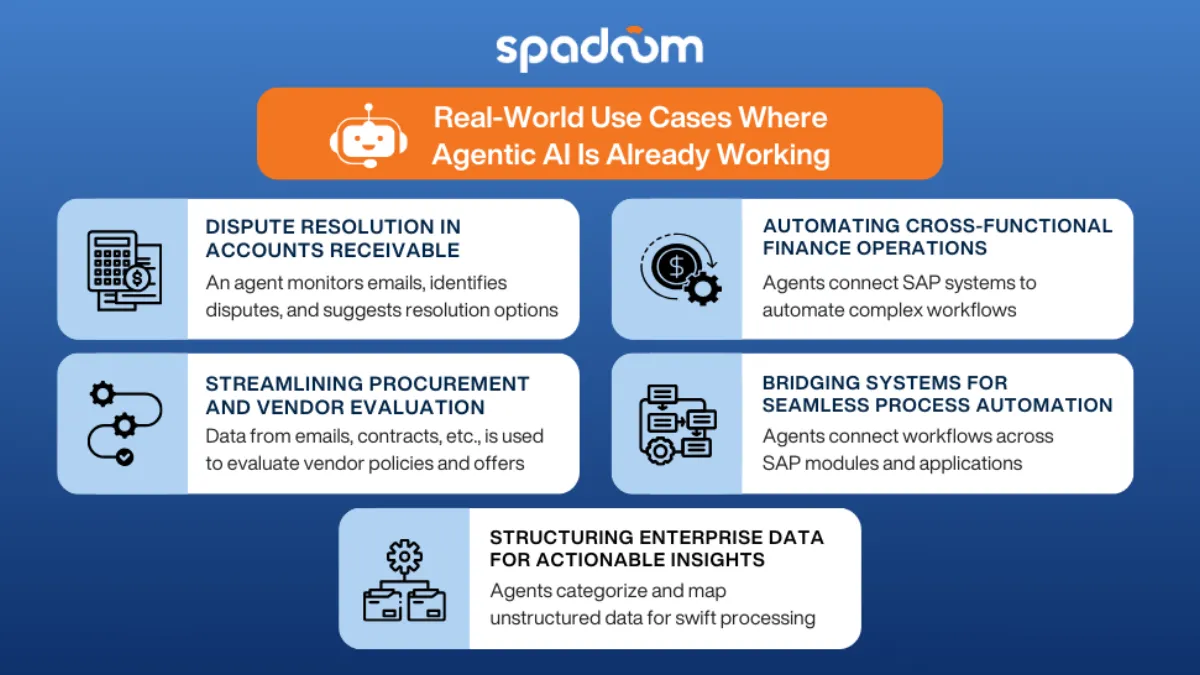
Dispute Resolution in Accounts Receivable
SAP’s financial tools use agentic AI to manage customer invoice disputes. An agent scans incoming messages, identifies potential issues, compiles a case summary, and recommends solutions. All before a human opens the ticket. Solid time saver for any AR team dealing with volume.
Automating Cross-Functional Finance Operations
Joule agents close gaps between siloed systems in finance, operations, and customer service. When validating a payment dispute, an agent can extract invoice metadata, match customer history, verify account status, and flag anomalies without manual routing. SAP’s Cash Management Agent alone reduces manual effort by up to 70% (SAP News Center, 2026).
Streamlining Procurement and Vendor Evaluation
Procurement teams using SAP can apply agentic AI to evaluate vendor options without sifting through piles of fragmented documentation. An agent accesses contract PDFs, scans compliance policies, compares quotes, and summarises pros and cons based on company criteria. It can spot red flags like outdated certifications or conflicting clauses. The kind of work that takes a procurement analyst hours, done in minutes.
Bridging Systems for Process Automation
One of the most valuable uses of agentic AI within SAP, in my opinion, is system bridging. Agents connect modules like S/4HANA, SuccessFactors, Sales Cloud V2, and third-party applications to keep processes running without interruption. Onboarding a new employee, fulfilling a sales order: agents coordinate steps across platforms without relying on human prompts. This is where the real enterprise value sits.
Structuring Enterprise Data
SAP agents help companies manage unstructured data that would otherwise slow down decisions. A Joule agent can read incoming emails, classify them by issue type, extract the important bits, and assign routing tags for downstream teams. Not glamorous work. But it’s the kind of thing that eats hours when done manually.
What Should You Consider Before Deploying Agentic AI?
A survey of 1,600 executives across eight countries found that organisations currently see a 16% return on AI investments, expected to nearly double within two years (SAP News Center, 2025). But that return depends on getting the foundations right. Most companies underestimate this part.
Data Readiness
AI agents make decisions based on what they see in real time. If the data feeding those decisions is incomplete or outdated, the risk of flawed actions goes up. Evaluate the health of your data pipelines. Make sure the systems feeding agentic workflows are connected and synchronised. Nota bene: garbage in, garbage out applies to AI agents just as much as it does to spreadsheets.
Process Visibility
Before you assign agents to execute tasks, you need a clear view of how those tasks actually run today. What steps are involved, where bottlenecks happen, which teams are responsible. A mapped process is far easier to automate than one that lives in people’s heads.
Governance and Control
Autonomy requires oversight. Deploy agentic systems with defined boundaries, decision rights, and auditability. In compliance-heavy industries, these controls aren’t optional. SAP supports this through built-in explainability features that let teams understand how an agent arrived at a decision. If you’re in a regulated space, insist on this from day one.
Human-AI Collaboration
Agentic AI shouldn’t operate in isolation. It needs to work within team structures and human decision-making authority. When agents are positioned as collaborators rather than replacements, adoption improves and value grows. Clear role definition builds trust. Skip this and you’ll face pushback from the people who actually need to work alongside these agents every day.
Is Your Organisation Ready for Agentic AI?
Enterprise AI has reached the point where systems don’t just support workflows. They help run them. SAP already has 34,000 customers using Business AI (SAP News Center, 2025), and Joule adoption grew ninefold throughout 2025 (Futurum Group, 2026). This isn’t happening in the future. It’s happening now.
The question isn’t whether agentic AI is viable. It’s whether your operations are prepared to use it well. That means aligning teams, cleaning up data flows, and assigning clear roles for when and how agents act. The technology is ready. The question is whether you are.
FAQ
What’s the difference between agentic AI and regular automation?
Regular automation follows predefined rules: if X happens, do Y. Agentic AI evaluates context, plans a multi-step approach, and adapts based on outcomes. It can handle situations it hasn’t been explicitly programmed for, as long as the goal and boundaries are defined. Think of automation as a conveyor belt. Agentic AI is more like a logistics coordinator who can reroute on the fly.
What is an example of agentic AI in enterprise use?
SAP’s Cash Management Agent. It analyses cash positions across accounts, identifies discrepancies, reconciles entries, and flags anomalies. Reduces manual effort by up to 70% (SAP News Center, 2026). Operates within defined guardrails but handles the full workflow autonomously.
Is agentic AI based on large language models?
Often, yes. Many agentic systems use LLMs for reasoning and natural language understanding. SAP’s Joule dynamically selects from multiple LLMs (OpenAI, Microsoft, Google) depending on the task, so it’s not locked to a single model. But agentic AI is a design pattern, not a specific technology per se. It can also run on rule-based systems augmented with ML.
How big is the agentic AI market?
Precedence Research values the market at $7.55 billion in 2025, projecting $199 billion by 2034 at a 43.84% CAGR (Precedence Research, 2025). Gartner predicts agentic AI could drive over $450 billion in enterprise software revenue by 2035, up from 2% of revenue in 2025.
Is agentic AI ready for production?
Depends on the use case. Structured tasks with clear outcomes (invoice processing, case classification, data routing) work well today. Open-ended tasks requiring subjective judgement are still maturing. SAP’s Joule Studio (GA in Q1 2026) makes it easier to build and deploy custom agents, but governance and data quality remain the gatekeepers. I reckon that’ll be the case for another year or two at least.
Solutions for Sales
See how SAP Sales Cloud V2 can work for your business.
Related Articles

SAP Sales Cloud V2 for Wholesale and Distribution: Orders, Routes, and Margins
Wholesale distributors live on thin margins and complex pricing. Here's how SAP Sales Cloud V2 connects your sales team to real-time inventory, customer-specific pricing, and order history — without middleware.

SAP Sales Cloud V2 for Professional Services: Pipeline, Proposals, and People
Professional services firms don't sell products — they sell people, expertise, and trust. Here's how SAP Sales Cloud V2 handles the unique CRM challenges of consulting, legal, accounting, and engineering firms.

SAP Commerce Cloud in Switzerland and the DACH Region: Implementation Guide
Implementing SAP Commerce Cloud in the DACH region requires more than a standard deployment. Multi-currency (CHF/EUR), four languages, Swiss payment systems, nDSG compliance, and local logistics. Here's how we handle it.