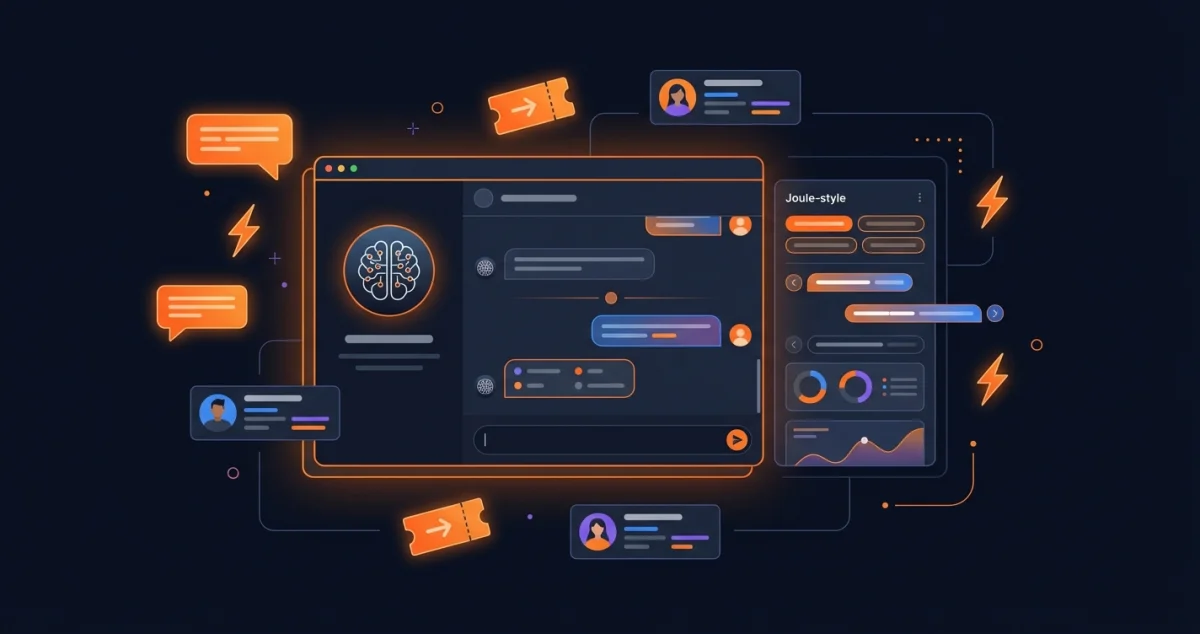
Digital Service Agents in SAP Service Cloud V2 — What Joule AI Actually Does
Spadoom
SAP Gold Partner
AI in customer service has been promised for a decade. The pitch has stayed the same every year: “AI will handle your tickets so your agents don’t have to.” Most of those promises delivered a chatbot that frustrated customers and a dashboard nobody checked.
SAP Service Cloud V2 takes a different approach. Instead of replacing agents, it puts AI behind the agent — classifying, routing, summarising, and suggesting. And with Joule Studio reaching general availability in Q1 2026, you can now build custom AI agents that handle specific workflows end to end.
Here’s what actually ships, what works, and where the limits are.
TL;DR: SAP Service Cloud V2 ships five production-ready AI capabilities: real-time sentiment analysis, ML-based case routing, context-aware response suggestions, case summarisation, and knowledge article recommendations. Joule Studio (GA Q1 2026) lets you build custom agents — like a warranty-check bot that queries S/4HANA before a human touches the case. The result: agents handle more volume, new hires ramp faster, and SLA compliance improves. But AI suggestions need clean data and a feedback loop. This is a tool for your team, not a replacement.
What Joule Does Out of the Box
SAP now offers over 350 AI features with 2,400+ Joule skills across its cloud portfolio (SAP News Center, 2026). In Service Cloud V2, five capabilities are production-ready and delivering measurable results today.
Sentiment analysis — real-time, not after the fact
Every incoming message — email, chat, web form — gets analysed for sentiment as it arrives. Joule doesn’t just tag messages as “positive” or “negative.” It tracks sentiment within a conversation, so if a customer starts calm and turns frustrated three messages in, the system flags the shift.
Why this matters in B2B: a single account can represent six or seven figures of annual revenue. Catching frustration early — before the customer escalates to their account manager or, worse, your competitor’s sales team — is worth real money. The sentiment flag triggers priority adjustments automatically. No one needs to read between the lines.
Intelligent case routing — ML, not static rules
V1 routed cases with rules: “If product = X and region = EMEA, assign to Team A.” These rules break the moment your organisation changes, a team member goes on leave, or a new product line launches.
V2’s routing uses machine learning. It considers the case content, customer history, agent skills, current workload, and historical resolution patterns. A case about S/4HANA integration issues goes to the agent who has resolved similar cases fastest — not just the agent tagged with “ERP” in a static skills matrix.
The practical difference: fewer reassignments, shorter time-to-resolution, and fewer cases sitting in the wrong queue for hours. One of our clients saw reassignment rates drop by 35% within the first quarter after switching from rule-based to ML-based routing.
Suggested responses — context-aware drafts
When an agent opens a case, Joule drafts a response based on:
- The case description and classification
- The customer’s history (past cases, products, contract tier)
- Similar resolved cases and their successful responses
- Relevant knowledge base articles
The agent reviews, edits, and sends. They don’t stare at a blank text field. For common issues — order status inquiries, configuration questions, known bugs — the suggestion is often 80–90% ready. For complex issues, it provides a structured starting point.
This is where AI saves the most time in day-to-day service operations. We’ve measured 30–40% reduction in average handling time for response drafting across deployments — consistent with what other agent-facing AI features deliver.
Case summaries — for cases with long histories
B2B support cases aren’t always quick. Some run for weeks. By the time a case gets escalated or handed to a different agent, the history might include 30 messages, internal notes, and three handoffs.
Joule generates a structured summary: what the customer reported, what’s been tried, what’s still open, and where the case stands. An agent picking up an escalated case gets context in 30 seconds instead of spending 15 minutes reading the full thread.
This is especially valuable during shift handoffs and when specialists get pulled into cases they didn’t start.
Knowledge article recommendations
When Joule classifies a case, it also surfaces relevant articles from your knowledge base. The agent sees recommended articles alongside the case — no manual search required.
The quality depends entirely on your knowledge base. If your articles are outdated, poorly tagged, or incomplete, the recommendations won’t help. But if you’ve invested in good documentation, this feature closes the gap between “the answer exists somewhere” and “the agent found it in five seconds.”
Joule Studio — Building Custom AI Agents
The five built-in capabilities cover the common patterns. But every company has specific workflows that generic AI can’t handle. That’s where Joule Studio comes in.
Joule Studio reached general availability in Q1 2026. It’s a development environment for building custom AI agents that plug into Service Cloud V2 (and other SAP CX modules). You define what the agent does, what data it can access, and what actions it can take — without writing ML models from scratch.
Think of it as the difference between using a pre-built app and building your own. The pre-built features handle 80% of use cases. Joule Studio handles the other 20% — the workflows specific to your industry, your processes, your integration landscape.
Example: warranty-check agent
A manufacturer we work with receives 200+ warranty claims per week. Before Joule Studio, an agent would open the case, read the claim, then manually check the product serial number in S/4HANA for purchase date, warranty status, and service history. That lookup alone took 4–6 minutes per case.
The custom agent we built does this:
- Reads the incoming case and extracts the serial number
- Queries S/4HANA via BTP integration for warranty status, purchase date, and prior claims
- Checks the claim against warranty terms (coverage period, exclusions, claim limits)
- Attaches the warranty status summary to the case before a human agent opens it
By the time the agent sees the case, the warranty check is done. Covered? The agent confirms and initiates the return. Not covered? The agent has the details to explain why, with specifics — not a generic “your warranty has expired” message.
Result: average handling time for warranty cases dropped from 12 minutes to under 5. The agent’s job shifted from data lookup to customer communication.
Example: first-response agent
Another pattern we’ve implemented: an agent that drafts the initial acknowledgement and response based on case classification.
The logic:
- Case arrives and gets auto-classified (category, subcategory, priority)
- The custom agent evaluates the classification and matches it against response templates
- It drafts a response that includes the right acknowledgement, sets expectations for resolution time based on the SLA tier, and includes any immediately relevant self-help resources
- The draft lands in the agent’s inbox for review and send
For a team handling 500+ cases per day, this removes the first 2–3 minutes of every interaction. Multiply that across the team and you recover significant capacity without adding headcount.
What This Means for B2B Service Teams
The impact isn’t abstract. It shows up in three specific ways.
Your existing agents handle more volume. Response suggestions, case summaries, and automatic routing eliminate the administrative overhead that eats into every interaction. We consistently see 25–35% improvements in cases-per-agent-per-day after deploying the full Joule feature set. That’s not because agents work faster — it’s because they spend less time on tasks that aren’t customer communication.
New agents reach competency faster. In B2B service, ramp time is a real problem. A new hire needs months to learn your products, your customer base, and your internal processes. AI suggestions act as a built-in mentor. When a new agent opens a complex case, they see a suggested response based on how experienced agents have handled similar issues. Knowledge article recommendations surface the right documentation automatically. We’ve seen ramp time for new agents decrease by 40% at one client — from 12 weeks to about 7.
SLA compliance improves because routing is smarter. Static routing rules can’t adapt to load spikes, agent availability changes, or unusual case patterns. ML-based routing distributes work based on real-time capacity and historical performance. Cases reach the right agent faster, and priority cases don’t get stuck behind lower-priority work in a shared queue. One client improved SLA compliance from 78% to 93% — primarily from better routing, not faster agents.
For a deeper look at what’s architecturally different about V2 compared to V1, see our complete Service Cloud V2 features guide.
What Joule Doesn’t Do (Yet)
We build this for clients every day. We’re also honest about the limits. Setting realistic expectations matters more than hype.
It doesn’t replace trained service agents. Joule assists agents. It doesn’t run your service desk. Complex B2B cases — multi-system issues, contractual disputes, escalations involving multiple stakeholders — require human judgement, empathy, and domain expertise that AI can’t replicate. The goal is to free agents from routine work so they can spend more time on these complex cases.
Custom agents need good data and clear rules. The warranty-check agent works because the S/4HANA data is clean, the warranty terms are structured, and the integration is well-configured. If your master data is a mess, your custom agents will produce unreliable results. Garbage in, garbage out — this hasn’t changed just because the garbage processor is now AI-powered.
AI suggestions need a feedback loop to improve. Out of the box, response suggestions are based on historical patterns. If agents accept bad suggestions without correcting them, the model doesn’t improve. You need a process where agents flag poor suggestions, and someone reviews the feedback regularly. The companies that get the best results from Joule treat it as a system that learns — which means they invest in teaching it.
Joule Studio agents aren’t no-code. The marketing says “build AI agents without coding.” The reality: you need someone who understands BTP integration, data models, and workflow design. You can configure agents in Joule Studio without writing Python or training a model, but you can’t do it without technical expertise. Plan for consulting support or upskill your internal team.
For more context on how agentic AI is developing across SAP’s CX suite, including the sales side, we’ve written a separate deep dive.
How Spadoom Implements Joule for Service Teams
We’re an SAP Gold Partner. We’ve deployed Service Cloud V2 with Joule across multiple B2B organisations. Here’s the approach that works:
Week 1–2: Baseline and data assessment. We measure your current service metrics — average handling time, first-response time, reassignment rate, SLA compliance — and assess data quality. If your knowledge base has 500 articles and 400 of them are outdated, we fix that first. AI built on bad data wastes everyone’s time.
Week 3–4: Core Joule activation. We turn on sentiment analysis, ML routing, response suggestions, case summaries, and knowledge recommendations. This is configuration, not development. We tune the routing model against your team structure and case patterns.
Week 5–8: Custom agents (if applicable). If your workflows need custom agents — warranty checks, approval routing, automated first responses — we build them in Joule Studio. Each agent gets tested against real case data before going live.
Ongoing: Feedback loop and tuning. AI features improve with use. We set up feedback mechanisms for agents to flag poor suggestions, review suggestion accuracy monthly, and retune routing models quarterly. This isn’t a “deploy and walk away” engagement.
The timeline varies by complexity. A straightforward deployment with the five core features takes 3–4 weeks. Adding custom agents adds 2–4 weeks depending on the integration landscape.
We’ve also written a hands-on guide to Joule in Sales Cloud V2 that covers the technical activation steps in detail. Many of the BTP and AI Foundation configuration steps are shared across modules.
Ready to see what Joule can do for your service team? Talk to us — no pitch deck, just a conversation about your setup.
Frequently Asked Questions
Do I need a separate licence for Joule and digital service agents?
Yes. Joule requires the SAP AI Foundation entitlement on SAP BTP, which is separate from your Service Cloud V2 subscription. Some newer contracts bundle basic Joule features, but custom agents via Joule Studio and advanced capabilities may require additional entitlements. Licensing for SAP Business AI is evolving — check with your SAP account executive or ask us to review your contract. Getting the entitlements wrong can delay a project by weeks.
How accurate is the AI case classification out of the box?
It depends on your case volume and data quality. Most deployments start at 70–80% classification accuracy in the first month. As agents correct misclassifications and the model learns from your specific patterns, accuracy typically reaches 85–90% within three to four months. High-volume operations (1,000+ cases/month) train the model faster. Low-volume operations take longer and may need manual tuning.
Can digital service agents handle cases completely without human involvement?
For specific, well-defined workflows — yes. The warranty-check agent and first-response agent examples in this post are real. But “completely autonomous” only works for predictable patterns with structured data. Complex cases, edge cases, and anything requiring judgement still need a human. The realistic expectation: digital service agents handle 15–25% of cases fully autonomously and assist agents on the rest. That 15–25% is often the highest-volume, lowest-complexity work — exactly the cases that burn out good agents.
Solutions for Service
See how SAP Service Cloud V2 can work for your business.
Related Articles

SAP Service Cloud V2 Implementation Guide — Step by Step for B2B Teams
A practical step-by-step guide to implementing SAP Service Cloud V2 for B2B service organisations. Covers planning, configuration, ERP integration, go-live, and hypercare — based on real project experience.

SAP CX AI Toolkit: What's Actually Available, What's Preview, and What's Still Roadmap?
We break down every AI feature across SAP Sales Cloud, Service Cloud, Emarsys, and CDP — sorted by what works in production today, what's in limited preview, and what SAP hasn't shipped yet.

The SAP Cloud Suite: How Commerce, Sales, and Service Cloud Work Together
SAP Commerce Cloud, Sales Cloud V2, and Service Cloud V2 each solve different problems. Here's how they connect, where they overlap, and what an integrated implementation looks like.